



Identifying Skin Diseases in Dogs
INFORMATION TO HELP PROTECT YOUR
PET
This
article prepared especially for NZYMES.COM
If your pet is suffering from a topical skin problem or you have been told your pet has allergies. Please read... Intructions for Yeast Problems
The following sections serve as an introduction to skin diseases in dogs, and suggest where to look to find the cause of a problem.
The ITCHY
SKIN DISEASES in the first section are characterized
by constant scratching, biting at the skin and rubbing
up against objects to relieve the itch.
The next two sections list diseases
characterized by HORMONE-RELATED
AND OTHER DISESES
WITH HAIR LOSS with few if any other symptoms. Hair
loss can mean impaired growth of new hair, in which case
it usually involves specific areas or the entire coat.
Or you may see patches of hair loss on various parts of
the body. In general, hair loss caused by hormonal diseases
is symmetric (the same on both sides of the body), while
that caused by parasites and other causes is asymmetric.
The next section lists SKIN
DISEASES WITH PUS DRAINAGE in which the predominant
sign is skin infection - pyoderma. Pyoderma is characterized
by pus, infected sores, scabs, ulcerations, papules, pustules,
furuncles, boils and skin abscesses. The skin infection
is often secondary to some other skin disease, particularly
an itchy skin disease that causes the dog to attack his
own skin.
The section after that lists AUTOIMMUNE
and IMMUNE-MEDIATED SKIN DISEASES, characterized by
blebs. Blebs, also called vesicles, are blisters that
contain clear fluid. Large ones are called bullae. All
tend to progress through rubbing, biting and scratching,
eventually producing skin erosions, ulcers and crusts.
Look for these changes to appear first on the face, nose,
muzzle and ears.
During the course of grooming,
playing with or handling your dog, you may discover a
lump or bump on or beneath the skin. To learn what it
may be, see the last section on LUMPS
AND BUMP OR BENEATH THE SKIN.
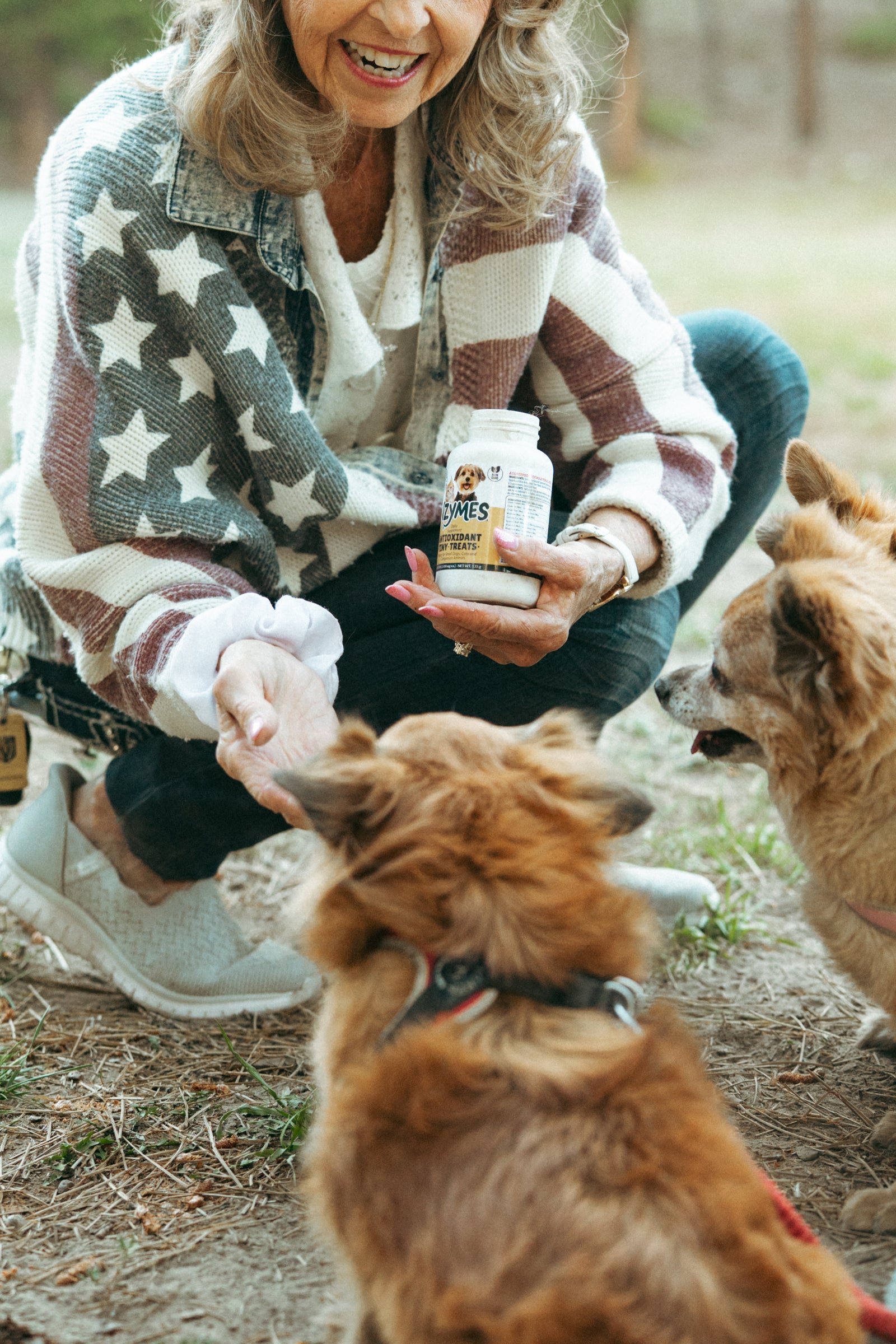
NZYMES® powerful formulas have proven their helpfulness in Vet studies, with nutrition conscious veterinarians and pet owners who have used this powerful formula for years to help strengthen the immune system, reduce pain, restore mobility and increase vitality in animals of all ages.
We suggest you read a few our dog testimonials
|
 |
|
|
 |
(See
Intructions for Yeast Problems)
Allergic contact dermatitis: Same as contact
dermatitis, but rash may spread beyond area of contact.
Requires repeated or continuous exposure to allergen
(such as wearing a flea collar).
Canine atopy: Severe itching that occurs in young
dogs and begins in late summer and fall. Caused by seasonal
pollens. Occurs in mixed breeds as well as purebreds.Common.
Chiggers: Itching and severe skin irritation
between toes, and around the ears and mouth. Look for
barely visible red, yellow or orange chiggers.
Contact dermatitis: Red, itchy bumps and inflamed
skin at the site of contact with chemical, detergent,
paint or other irritant. Affects feet and hairless parts
of the body.
Damp hay itch (Pelodera): Red pimplelike bumps
on skin. Severe itching. Occurs in dogs bedded on damp
hay and similar grass.
Flea allergy dermatitis: Red, itchy pimplelike
bumps over the base of the tail, back of rear legs and
inner thighs. Scratching continues after fleas have
been killed.
Fleas: Itching and scratching along the back,
around the tail and hindquarters. Look for fleas, or
black and white gritty specks in hair (flea feces and
eggs).
Fly-bite dermatitis: Painful bites at tips of
erect ears and bent surfaces of floppy ears. Bites become
scabbed, crusty-black and bleed easily.
Grubs: Inch-long fly larvae that form cystlike
lumps beneath the skin with a hole in the center for
the insect to breathe. Often found beneath chin or along
abdomen.
Lice: Two-millimeter-long insects, or white grains
of "sand" (nits) attached to hair. Not common. Found
in dogs with matted coats. May have bare spots where
hair has been rubbed off.
Lick granuloma (acral pruritic dermatitis): Red,
shiny skin ulcer caused by continuous licking at wrist
or ankle. Usually seen occuring in large, short-coated
breeds.(See Intructions for Yeast Problems)
Maggots: Soft-bodied, legless fly larvae found
in damp matted fur.
Scabies (Sarcoptic mange): Intense itching. Small
red spots that look like insect bites on the skin of
the ears, elbows and hocks. Typical crusty ear tips.
Ticks: Large insects attached to skin. May swell
up to size of pea. Found beneath ear flaps and where
hair is thin.
Walking dandruff (Cheyletiella mange): Occurs
in puppies 2 to 12 weeks of age. Large amounts of dry,
scaly, flaky skin over the neck and back. Itching is
variable.
|
 |
|
|
 |
Cortisone excess: Symmetric hair loss over trunk
and body. Abdomen is pot-bellied and pendulous. Seen
with Cushing's syndrome. In some cases the dog is taking
steroids.
Growth hormone-responsive alopecia: Bilaterally
symmetric hair loss. Begins around puberty. Breed specific
involvement.
Hyperestrogenism (Estrogen excess): Occurs in
females and males. Bilateral symmetric hair loss in
perineum and around genitals. Enlarged vulva and clitoris;
in males, pendulous prepuce.
Hypoestrogenism (Estrogen deficiency): Occurs
in older spayed females. Scanty hair growth and thinning
coat, initially around vulva and later over body. Skin
is smooth and soft, like a baby's.
Hypothyroidism: Most common cause of bilaterally
symmetric hair loss without itching. Coat is thin, scanty
and falls out easily. Involves the neck beneath the
chin to the brisket, sides of body, backs of thighs
and top of tail.
|
 |
|
|
 |
Acanthosis nigrans: Mainly in Dachshunds. Hair
loss begins in armpit folds. Black, thick, greasy, rancid-smelling
skin.
Color mutant alopecia (Blue Doberman syndrome):
Loss of hair over the body, giving a moth-eaten look.
Papules and pustules appear in areas of hair loss. Also
affects other breeds.
Demodectic mange: Localized - Occurs in puppies.
Hair loss around eyelids, lips and corners of mouth,
giving a moth-eaten look. Fewer than five patches, up
to one inch in diameter. Generalized-Numerous patches
that enlarge and coalesce. Severe skin problem complicated
by pyoderma. Primarily affects young adults.
(See Intructions for Yeast Problems)
Nasal solar dermatitis (Collie nose): Loss of
hair at junction of nose and muzzle. Can lead to severe
ulceration. Affects dogs with lightly pigmented noses.
Pressure sores (Calluses): Gray, hairless, thickened
pads of wrinkled skin, usually over elbows but may involve
other pressure points. Caused by lying on hard surfaces.
Ringworm: A fungal infection. Scaly, crusty circular
patches 1/2 to 2 inches across. Patches show central
hair loss with a red ring at the periphery. Some cases
show widespread involvement.
Utilizing a 2% Solution of OX-E-DROPS or
uisng Tincture
of BlackLeaf straight can be very effective
in combating these fungal problems
Sebaceous adenitis: Mainly in Standard Poodles.
Symmetrical loss of hair over face, head, neck and back.
Dandruff-like scales and hair follicle infection can
develop.
Seborrhea: Dry type - similar to heavy dandruff.
Greasy type - yellow brown greasy scales that adhere
to hair shafts; rancid odor.
(See Intructions for Yeast Problems)
Zinc-responsive dermatosis: Crusty, scaly skin
with hair loss over the face, nose, elbows and hocks.
Cracked feet. Caused by zinc deficiency. Arctic breeds
most susceptible.
|
 |
|
|
 |
Actinomycosis and norcadiosis: Uncommon skin
infections with abscesses and draining sinus tracts
that discharge pus and respond slowly to treatment.
Acute moist dermatitis (Hot spots): Rapidly advancing
patches of inflamed skin from which the hair falls out.
The skin is covered with a wet exudate of pus. Progresses
through self-chewing and results in pyoderma. (See Intructions for Yeast Problems)
Cellulitis or abscess: Painful, warm, reddened
skin, or pockets of pus beneath the skin. Look for a
cause (such as a foreign body, bite wound, self-trauma
from irritative skin disease).
Folliculitis (Hair pore infection): Hair shaft
protrudes through center of pustule. Superficial-Similar
to impetigo, but extends to involve armpit folds and
chest. Deep-Pustules become larger and firmer. Pus,
crusts and draining tracts in the skin.
Impetigo: Pimple-like bumps (pustules) and thin
brown crust on hairless skin of abdomen and groin. Occurs
in young puppies.
Interdigital cysts: A swelling between the toes
that may open and drain pus.
Mycetoma: Painful swelling at the site of a puncture
wound, usually on legs or feet. Pus drains through sinus
tracts deep in the mass.
Puppy acne: Purplish red bumps (pustules) on
the chin and lower lip. Not painful. (See this story)
Puppy strangles (Juvenile pyoderma): Painful
swelling of face (lips, eyelids, ears), followed by
rapid appearance of pustules and draining sores. Occurs
in puppies under four months of age.
Skin fold pyoderma (Skin wrinkle infection):
Red, inflamed skin with a foul odor in lip fold, nose
fold, vulvar fold and tail fold.
(See Intructions for Yeast Problems)
|
 |
AUTOIMMUNE
AND IMMUNE MEDIATED SKIN DISEASES - Back
to Top
|
 |
Bullous pemphigoid: Similar to pemphigus vulgaris
(see below), but usually begins at the junction of skin
and mucous membranes. Mouth is commonly involved.
Discoid lupus erythematosus: Affects the flat
surface of the nose. Ulceration and depigmentation are
characteristic.
Erythema multiforme: Acute eruption of skin and
mucous membranes. Often caused by drugs. Characteristic
target-like eruptions with red rims and blanching at
center.
Pemphigus erythematosus: Similar to pemphigus
foliaceus, but restricted to face, head and footpads.
Pemphigus foliaceus: Red skin patches (raacules)
that progress rapidly to pustules and then to dry yellow
crusts. Usually limited to face (nose, muzzle, around
eyes, ears). Crusts adhere to underlying skin and hair.
Often becomes generalized. Depigmentation seen in late
stages. The feet can become thickened and cracked. Occasionally
only the footpads are involved.
Pemphigus vegetans: Flat-topped pustules involving
skin folds. Heals with wart-like growths.
Pemphigus vulgaris: Vesicles and bullae (small
and large blisters) that ulcerate and form thick crusts.
Usually found around the lips and in the mouth, but
may be generalized. Ulceration of footpads and shedding
of nails are common.
Nodular panniculitis: Multiple lumps (like marbles
beneath the skin) over the back and along the sides.
Lumps open and drain, then heal by scarring.
Systemic lupus erythematosus: Skin involvement
similar to pemphigus foliaceus. First sign may be wandering
lameness. Ulceration of footpads is common.
Toxic epidermal necrolysis: Severe, painful skin
disease. Blebs and ulcers involve the skin, mucous membranes
and footpads. Large sections of skin are shed like a
bum.
|
 |
|
|
 |
Abscess: A painful collection of pus at the site
of a bite or puncture wound.
Basal cell tumor: Solitary nodule, usually on
a narrow base or stalk. Found on the head, neck and
shoulders of older dogs.
Ceruminous gland adenoma: A pinkish-white dome-shaped
growth in the ear canal less than one centimeter in
size. May become ulcerated and secondarily infected.
Epidermal inclusion cyst: A firm lump beneath
the skin. May discharge cheesy material and become infected.
Hematoma: A collection of clotted blood beneath
the skin; often involves the ear flaps.
Histiocytoma: Rapidly growing dome-shaped (button
like) growth found anywhere on the body, usually in
young adults.
Lipoma: Smooth round or oblong growth beneath
the skin; feels somewhat soft.
Mast cell tumor: Solitary or multiple growths
usually found on the trunk, perineum and legs. Breed
specific predisposition.
Melanoma: A brown or black-pigmented nodule found
in areas of dark skin. Growths in mouth and nail beds
usually are malignant.
Perianal gland tumor: A solitary or multinodular
growth in the perineum around the anus. Occurs in older
intact males.
Sebaceous adenoma: Smooth, pink, wart like growth
less than one inch in size. Most common on the eyelids
and limbs, Occurs in older individuals (average age
10).
Skin papillomas: These grow out from the skin
and may look like a wart. Not painful.
Soft-tissue sarcomas: Ill-defined or well-demarcated
masses of varying size and location. Often slow growing.
Squamous cell carcinoma: A non-healing gray or
reddish-looking ulcer found on the belly, scrotum, feet,
legs, lips or nose; may resemble a cauliflower like
growth.
Transmissible venereal tumors: Ulcerated often
multiple cauliflower-like growths on the genitalia of
dogs and bitches.
|
 |
|
|
 |
|