
- Success Stories
- LearnThe Resource Library: guides, articles, stories


Looking for help with
Most searched
Also common
Everything else
Joints & mobility
Immune & breathing
Injury & recovery
Legs, hooves & joints
Gut & breathing
When we first put Tracite on the shelf, the questions came in fast. Where does it come from? Why is mercury on the label? Can my dog have it too? Here are the straight answers, the same ones we'd give you if you called.
A lot of health comes down to one quiet question: is your body actually absorbing what you feed it? When the food we eat has been over-processed and grown in tired soil, it simply can't deliver everything the body needs, and over time health slides. That's where Tracite comes in. A few drops in some juice or water each day, and the body gets a level of mineral nutrition it hasn't been getting from the plate.
We only make a handful of products, and each one has to earn its place by working seamlessly with the others and doing a real job for people and their animals. Tracite met that bar, and customers started telling us so almost immediately.
of your body's functions require minerals and trace elements
plant-derived trace minerals and elements, plus 18 amino acids, in every drop
to make one batch, using nothing but clean, fresh water
Here's the piece most people never hear. Vitamins, enzymes, probiotics, antioxidants: none of them can get to work on their own. Think of minerals as the delivery truck. They carry those nutrients to the cells that need them and hand them off inside. Every cell in the body also depends on trace minerals for a daily trickle charge of bioelectrical energy. Take the minerals away and even a good supplement routine has nowhere to go.
That's why Tracite works as a super transport system for nutrients, and why people who already take supplements often say they can feel the difference once they add it. It's also the mechanism behind what Mike calls the multiplying effect below.
Before we get to specific questions, it helps to know how Tracite is made, because it isn't really "made" at all. Nobody follows a recipe. It's distilled down from something that already exists.
That something is organic humic and fulvic shale: a rare deposit of ancient plant matter, land and sea vegetation together, preserved for many thousands of years under layers of sand and clay. The sea covered this ground more than once over the ages, each time leaving behind a super-rich layer of plant minerals in their colloidal form. These deposits are the most concentrated organic mineral sources on Earth. Everything in them was already there, in the ground those plants grew from, and all of it, about 70 trace minerals plus 18 amino acids, is released very slowly using only clean, fresh water. No extraction acids, no chemicals. It takes about two years to create a batch.
Here's a thought worth holding onto: when you eat fruit, vegetables, or any plant food, you're consuming minerals in exactly this colloidal form. Tracite is simply that, drawn out of the ground for you.
Because it comes out of the earth that way, Tracite contains both ionic and colloidal particles. That makes its mineral makeup and ratios closer to the body's own fluids than any other naturally occurring trace mineral we've found. Even a good organic garden can't hand you that full range in a form the body takes up this easily.
This is the detail our biochemist cares about most. Most colloidal mineral products are sulfur-based, and the popular Salt Lake ionic minerals are extremely high in chloride. But the body's fluids, and plants themselves, are primarily iron and calcium, not sulfur or chloride. Tracite is iron-based and plant-derived, which is why its mineral profile looks more like your own blood than any other mineral product we know of. A useful rule of thumb when you're comparing bottles: a product with a lot of chloride or sulfur relative to iron may not be a plant-derived, water-soluble mineral at all.
of the bottle is actual dissolved mineral (250,000 to 350,000 mg/L). The tiny particle size of the shale makes that possible
µmhos/cm² of electrical conductivity. In plain terms: the more it conducts, the more mineral is in it
serves a family of four for a month. Other brands cost about the same for a month's supply for one
Some people get a jolt the first time they read our label, because we list every element found in Tracite, and a few of them are heavy metals: mercury, lead, and others. Here's the plain truth. Those elements come from the natural world. They were already present in minuscule amounts in the earth where these ancient plants grew, and they became part of the plants, the same way they're part of the foods we eat every day. Other companies that sell similar products often leave them off the label for fear of losing customers. We'd rather you know.
We want you to be sure that what's in Tracite is exactly what we say it is. It comes as found in nature. Nobody adds "a little of this" and "a little of that." The slow, pure-water process simply releases what the organic material has held for thousands of years.
Every batch of Tracite Minerals is tested for mineral content, trace element content, electrical conductivity, and impurities, and confirmed free of insecticide, bacteria, mold, and yeast contamination. We provide a certificate of analysis for all trace elements found. All heavy metals are well within safety margins.
Happy to. Those trace elements are inherent to the plant life Tracite comes from, and the other natural heavy metals on the list are there for the same reason. Companies making minerals for industry concentrate them on purpose. We don't. Concentrating one thing throws the whole balance off, and balance is the point. If we were trying to collect mercury, this source would be a complete waste of time.
The amounts are tiny. The national standard for mercury safety is under 0.10 ppm. Tracite's analysis comes in at 0.003 ppm. The thing to remember is that these elements are simply in the world; there's no escaping them. They're in the air we breathe, the water we drink, and the soil we walk on.
Both, and it always has been. When we first introduced Tracite, it came in one bottle with a weight chart on the side, and people wondered whether the pet dosing was an afterthought. It wasn't. Today Tracite Minerals for Pets is one of the most popular products in our lineup, with its own bottle and directions written for dogs. Add the drops to their food twice daily by weight. If your dog is fussy about food, you can also give it by oral syringe: add the right number of drops to 5cc of water and dispense along the gumline.
Most of us are short on minerals, and fixing that is job one. But there's a second thing we've seen: Tracite can have a multiplying effect on the other vitamins and supplements a person or pet is already taking, because, as our biochemist puts it, minerals are the transport system nutrients ride on. For anyone, two legs or four, dealing with yeast or another whole-body issue, that can change everything.
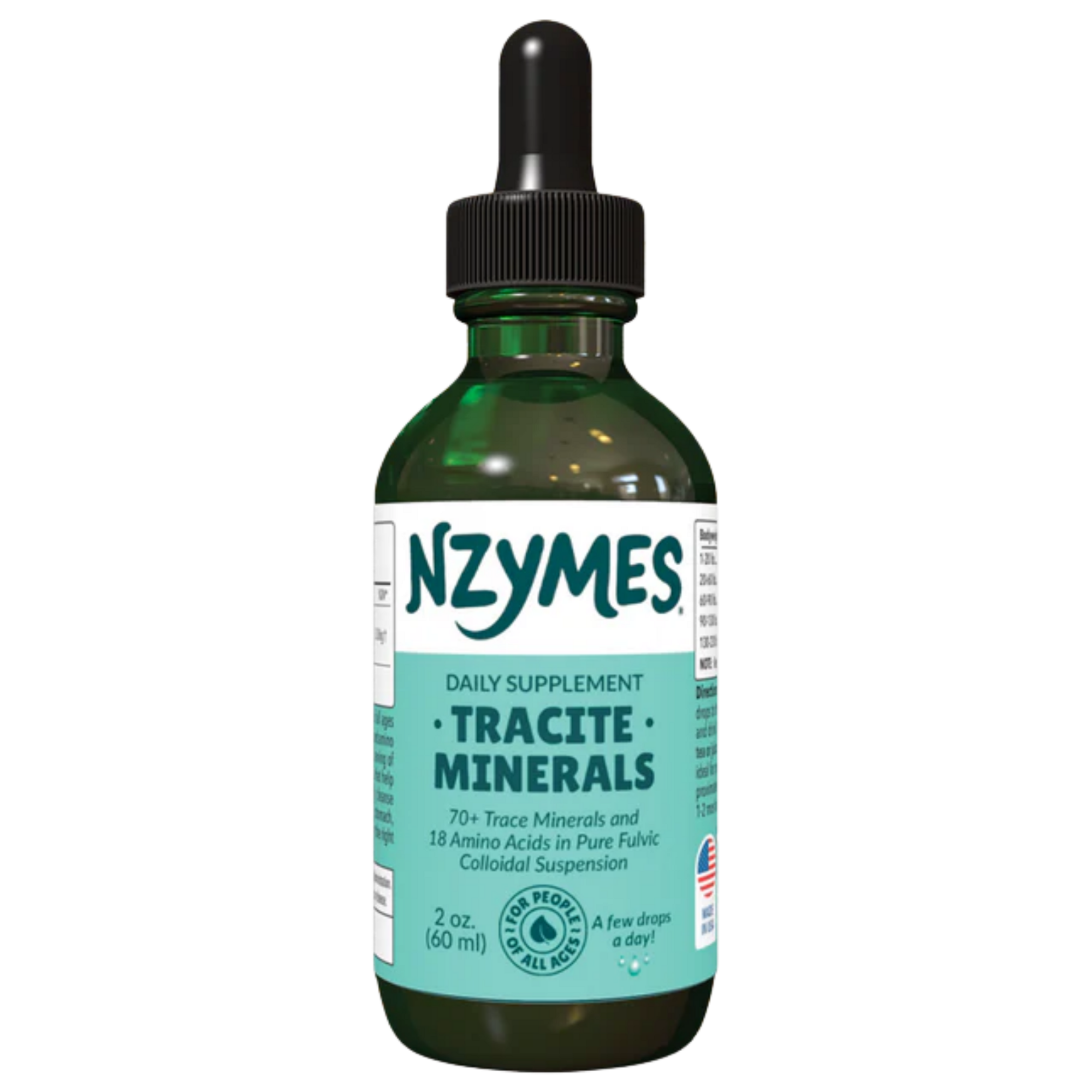
Daily trace mineral support in water or juice. Dosing, pricing, and the 120-Day Worry-Free Guarantee.
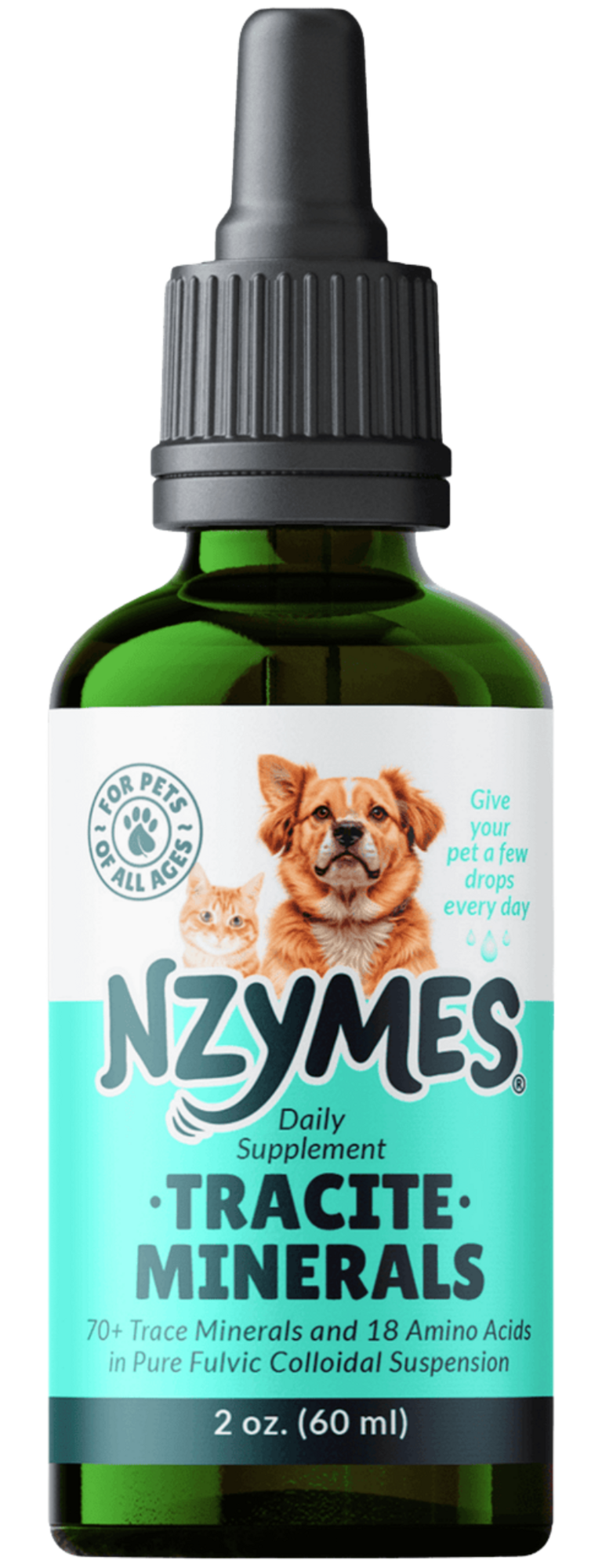
The same minerals with dog dosing by weight.
Two years in the making. Nothing added but water.
Every element on the label, because you deserve to know.
Organic humic and fulvic shale: layers of land and sea vegetation pressed and preserved over many thousands of years, the most concentrated organic mineral deposits on Earth. The minerals are released slowly with pure water only; a batch takes about two years.
Because they're there, in minuscule natural amounts, the same way they're in the food we eat. We list everything. Every batch is tested with a certificate of analysis, and all heavy metals are well within safety margins. Mercury, for example, tests at 0.003 ppm against a national standard of under 0.10 ppm.
Both. Tracite Minerals for Pets is one of our most popular products, with its own bottle and dog dosing by weight (twice daily on food, or by oral syringe in 5cc of water along the gumline). The People bottle carries directions for you. Same minerals in both.
7 drops twice daily in water, sparkling water, or juice (½ mL, about 14 drops, in 24 hours). Most people can't taste it; a few notice a faint mineral note, and a squeeze of lemon or lime covers it. Pets get it on food twice daily by weight, from 1–2 drops for a small dog up to 5–7 for a giant breed.
Plants and the body's own fluids are primarily iron and calcium. Most colloidal minerals are sulfur-based, and Salt Lake ionic minerals are very high in chloride. Tracite's iron base is what makes it closer to the mineral profile of human blood than other mineral products, and a quick way to spot a product that may not really be plant-derived.
Yes. Tracite is a completely natural product: whole-food, plant-derived minerals drawn out of the earth with nothing but water, the same colloidal form you take in every time you eat fruit or vegetables. It doesn't compete with medications the way a synthetic supplement might. If you're unsure about anything you or your pet are taking, we're here for free consultations; book one and we'll talk it through.
Because nothing is forced. The minerals are drawn out of the humic shale slowly, with clean fresh water only. No extraction acids, no chemicals, no shortcuts. Speeding it up would mean adding something, and we won't.
They describe the ancient plant material Tracite comes from. Humic shale is the compressed deposit itself; fulvic refers to the natural plant acids the minerals are bound to, which is the form plants take minerals up in and the form the body recognizes.
It's how much of the liquid is actual mineral rather than water. Tracite runs 25 to 35 percent (250,000 to 350,000 mg/L), which is unusually high, and it's possible because the shale's crystalline colloids are so extremely small.
The more a mineral solution conducts, the more mineral is in it. Tracite measures 28,000 µmhos/cm². Every cell in the body runs on a daily trickle charge of bioelectrical energy, and trace minerals are where it comes from.
Yes, and that's where it shines. Minerals are the delivery system vitamins and enzymes ride on, so Tracite tends to have a multiplying effect on whatever else you're already taking. Many people say they can feel the difference for that reason.
Two ounces serves a family of four for about a month at the recommended 7 drops twice daily. Other brands cost about the same for a month's supply for one person.
We only make a handful of products, and each one has to do a real job the others can't. Mineral deficiency is nearly universal, and minerals are what let everything else we make work better. Tracite earned its place on both counts.
Because dogs were part of the plan from the start. Today Tracite Minerals for Pets has its own bottle and directions, and it's one of the most popular products we make. Same minerals in both bottles.
Beyond addressing mineral deficiency, Tracite can have a multiplying effect on the other vitamins and supplements a person or pet is taking, because minerals are the transport system nutrients ride on. For anyone dealing with yeast or another whole-body issue, that can change everything.
Minerals, dosing, whether Tracite belongs in your plan or your dog's, or whether the gut needs attention first. Tell us what's going on and we'll tell you honestly.
We've been walking alongside people and their animals since 1999. The consultation is a scheduled half hour with the people who know these products best. It's free, and it always will be.