
- Success Stories
- LearnThe Resource Library: guides, articles, stories


Looking for help with
Most searched
Also common
Everything else
Joints & mobility
Immune & breathing
Injury & recovery
Legs, hooves & joints
Gut & breathing
Your DNA is the recipe book for your whole body, every hair, every organ. And your cells copy that recipe billions of times a day. What most people never hear is that those copies depend on trace minerals to come out right.
Our genetic code is complicated, and scientists are still learning how it works. But one finding keeps coming up: DNA leans on trace minerals far more than most of us realize. Our DNA determines everything about our physical bodies. It contains every instruction for life, for our bodies, and for our health.
That recipe book needs trace minerals to stay intact and to copy itself cleanly. Trace minerals are, quite literally, the building blocks of DNA. There are currently sixty-four recorded trace minerals needed for each and every copy of our DNA, and each one has a specific job in keeping us well and keeping our ability to heal switched on.
trace minerals currently recorded as necessary for every copy of our DNA
cells in an adult body, according to Dr. Olree
of those cells die and are replaced every day: an astounding number of DNA copies
Dr. Richard Olree has spent his career on minerals and the genetic code, and Charles Walters wrote a book about his work called Minerals for the Genetic Code. The Nutrition Therapy Institute has a short synopsis of his work: Dr. Richard Olree: Minerals for the Genetic Code. The book makes the case that minerals matter at every stage of the genetic life cycle, explains how and why our food has lost so many of them, and walks through what each deficiency looks like. Dr. Olree's conclusion is blunt: mineral shortages sit underneath many of the health problems we see today.
A few of the points from that work that stood out to us:
"Life could not be without selenium, and it is estimated that 2 out of 3 humans walking the earth are selenium deficient."
"Everything goes wrong when there is not enough iodine. Cardiovascular disease is prevalent among chronic iodine deficient related problems."
"Another problem is that testosterone starts to drop and estrogen goes up with low boron levels and is reversed with the addition of boron."Dr. Richard Olree, as quoted in Minerals for the Genetic Code
Three minerals, three very different jobs. Run short on any one and something real goes wrong.
Here's why it adds up so fast. An adult body is about fifty trillion cells, and one percent of them die and get replaced every day. That's an enormous number of DNA copies being made before you go to bed tonight. When the building-block minerals aren't there, the copies come out with mistakes, and, as Dr. Olree puts it, that's where a lot of trouble starts.
Beyond the problems you can see on the outside, the body's ability to heal itself stalls when the right trace minerals aren't there. A cell that can't find the mineral it needs grabs the closest look-alike and keeps going, just to stay alive. It's a smart emergency move, but it switches off parts of the code. The instructions for healing are still there, but they can't be reached, because the deficiency has blocked them. That can lead to all kinds of trouble, some as simple as premature aging, some far more serious. Put the right minerals back, and those healing instructions can be read again.
For years, many of us believed we could get all the trace minerals we needed by adding a bit of sea salt or Himalayan salt to our food. Many of the necessary minerals do exist in those salts, but they're not in a form the body can actually use. A mineral has to make a journey before your body can use it, and plants and soil bacteria are the middlemen. They change the mineral's electrical charge (its valence, if you want the technical word) into one that living tissue recognizes and is drawn to. In plants, that transformation happens during photosynthesis, as sunlight changes the electron valence of the absorbed minerals into one that living tissue can work with.
Trace minerals need to arrive in a plant-derived format, the form that soil bacteria and photosynthesis have already made compatible with living tissue.
We need all of them, together and in balance, not a few famous ones on their own.
The minerals have to carry the right electrical charge. Without it, they pass straight through instead of being put to work.
One of the biggest keys to this delivery system is a product our team tested for months before we put it on the shelf: Nzymes Tracite Minerals. It delivers all three of the above, and more:
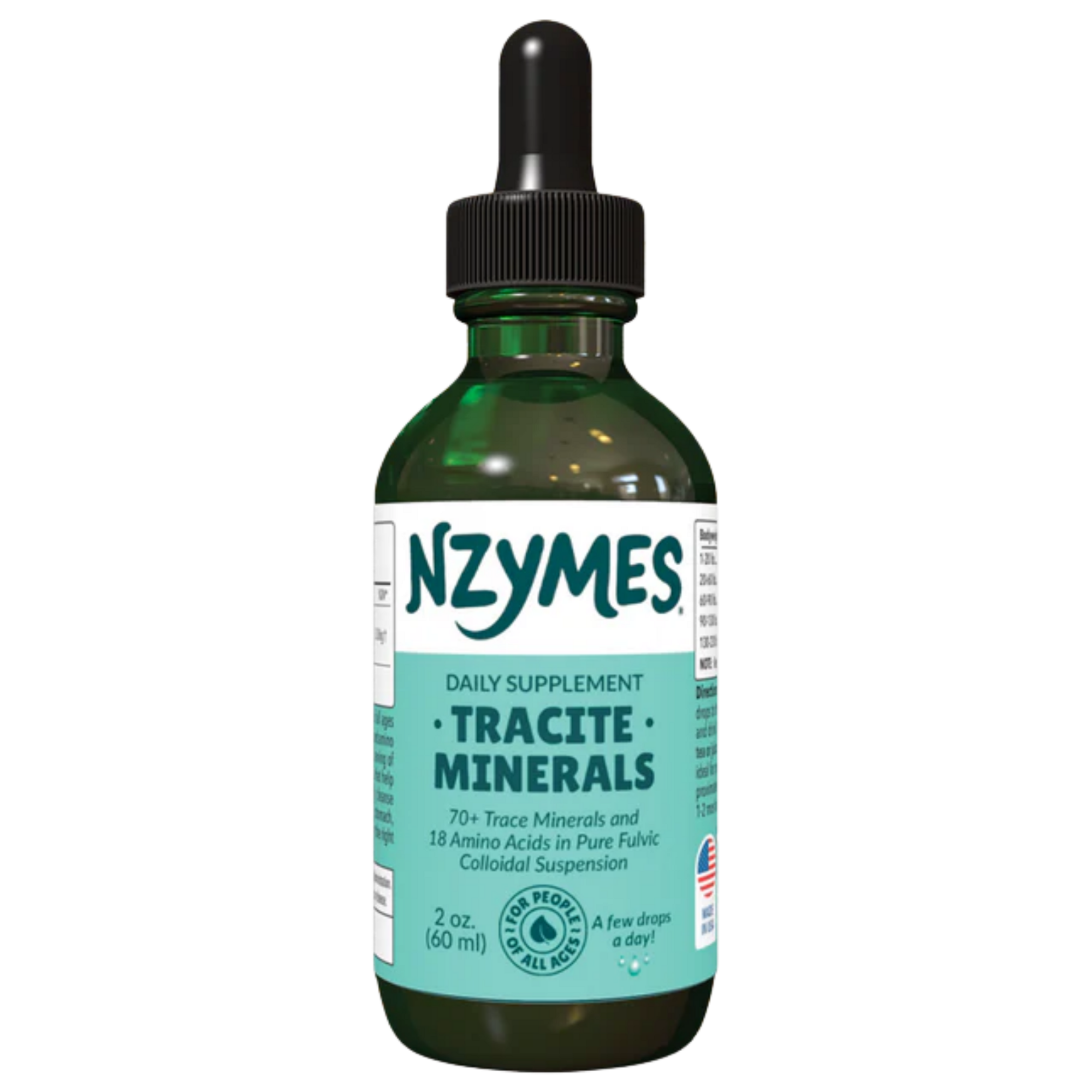
Over 70 trace minerals and elements, plant-derived and iron-based, rich in chromium, vanadium, selenium, and boron. Taken in water.
If you've been eating well and still feel like something's missing, this is a good place to start. Every product carries the 120-Day Worry-Free Guarantee.
Fifty trillion cells. Half a trillion new copies a day.
Every one of them needs the same sixty-four building blocks.
Every time a cell divides, it copies its DNA, and that copy depends on trace minerals to come out intact. Sixty-four trace minerals are currently recorded as necessary for each copy. When one is missing, the cell substitutes a similar mineral to keep going, which switches off parts of the code, including instructions for healing.
Many minerals are present in those salts, but not in a form the body can use. Minerals become absorbable when plants and soil bacteria transform their electrical charge (valence) into one compatible with living tissue. That's why plant-derived trace minerals matter.
Dr. Olree's work singles out selenium (he estimates two in three people are deficient), iodine, and boron, but his central point is that we need all of them, together and in balance, not a few in isolation.
In water, daily. It's plant-derived and iron-based, with over 70 trace minerals and elements, and it's easy on the stomach. Dosing by body weight is on the Tracite for People page.
Yes. Tracite is a completely natural product: whole-food, plant-derived minerals drawn out of the earth with nothing but water, the same colloidal form you take in every time you eat fruit or vegetables. If you're unsure about anything you're taking, we're here for free consultations; book one and we'll talk it through.
A researcher who has spent his career on minerals and the genetic code. Charles Walters' book Minerals for the Genetic Code is built on his work, and it's where the sixty-four-minerals finding and the quotes on this page come from.
A mineral's electrical charge. Plants and soil bacteria change that charge into one living tissue recognizes and is drawn to, which is why a plant-derived mineral is absorbed and a rock-derived one mostly isn't.
No. The approach that worked for our team was all three together: eating foods high in the minerals they were short on, supplementing the specific ones that mattered, and adding a plant-derived trace mineral like Tracite daily to cover the full range.
Because nobody hands you a shopping list of exactly which 64 you're short on. A full-spectrum, plant-derived source covers the range in balance, which is what Dr. Olree's work says the body needs.
Tell us what you're dealing with, what you're eating, and what you're taking, and we'll tell you honestly whether minerals are where to start, or whether it's the gut first.
We've been walking alongside people since 1999. The consultation is a scheduled half hour with the people who know these products best. It's free, and it always will be.