- Success Stories
- LearnThe Resource Library: guides, articles, stories

Looking for help with
Most searched
Also common
Everything else
Joints & mobility
Immune & breathing
Injury & recovery
Legs, hooves & joints
Gut & breathing
If your dog is constantly itching, licking their paws, shaking their head, or fighting ear infections that keep coming back, and you've already been to the vet, you're probably not getting the full picture. What most dogs in this situation are dealing with isn't primarily a skin problem. It starts much deeper than that.
Yeast lives in your dog's gut naturally, in small amounts. It's supposed to be there. In a healthy gut, billions of beneficial bacteria form a protective lining along the intestinal walls: they keep the yeast in check, aid digestion, and do a surprising amount of the immune system's work. By some estimates, as much as 70 percent of it.
The trouble begins when something disrupts that bacterial balance. Then the yeast, which is far tougher than the bacteria it lives beside, gets its opportunity.
Two things worth knowing up front: this isn't contagious, and it isn't your fault. Your dog didn't catch it at the dog park, and you didn't cause it by doing something wrong. The most common triggers are ordinary events: a round of antibiotics, a stretch of steroids, years of starch-heavy kibble, even a season of stress.
Beneficial bacteria line the gut and keep the small, natural yeast population exactly where it belongs.
Antibiotics, steroids, sugar-heavy food ingredients, or extended stress erode the protective bacterial colonies.
Opportunistic yeast expands into the space the bacteria used to hold, taking over stretches of the intestinal wall.
The overgrowth produces waste faster than the gut can handle. The overflow ends up in the bloodstream, and the body starts looking for ways to push it out.
It leaves through the paths of least resistance, often the lowest and dampest parts of the body: the ears, the eyes, the paws, the legs, the belly, the groin and the skin. That's the itching, the odor, the blackening skin you can finally see.
By the time the symptoms show on the outside, the problem has been building on the inside for a while. Which is why creams and sprays alone never quite finish the job.
When the gut's protective bacteria are depleted, the inflamed intestinal walls become more porous than they should be. Small particles of undigested food slip through into the body, where they don't belong. This is what's known as leaky gut, and it travels with yeast overgrowth. One rarely exists without the other. (Our leaky gut guide is the deeper dive.)
The immune system does exactly what it's supposed to do: it responds to anything out of place. But because those food particles look like foreign invaders, it looks like an allergic reaction, even when no true allergy exists. So the diagnosis comes back "allergies," and the cycle starts:
...and back to the itching. Around it goes, until someone finally looks at the gut.
Think of the immune system like a muscle. When it's working and being nourished, it grows stronger. When it's suppressed, much like a leg in a cast, it weakens. The medications manage the symptoms, but the imbalance underneath them carries on. When the drugs stop, the cycle often starts again.
Sound like your dog? Yeast is a tough fight, and the one we'd rather talk with you about before anything else. Book a free consultation →
Yeast feeds on sugars and starches. The simpler the starch, the faster it converts to sugar in the body, and the more it fuels the overgrowth. For a dog already fighting an imbalance, food quality isn't optional. Rebalancing the gut while feeding starch-heavy food is like washing the car while the kids keep throwing mud on it.
Check the first few ingredients on your dog's kibble bag. Ingredients are listed by weight, so the first three or four tell you what the food really is. If simple starches sit near the top, that's worth paying attention to. Be wary of "special" prescription foods too: many of them lean on the very starches that feed the yeast.
Prebiotics are the plant fibers the good bacteria feed on, often listed as chicory root, inulin or beet pulp; probiotics are the bacteria themselves.
Food is not a footnote in this. It's half the fight. We keep a living list of the foods we actually recommend, with the reasoning behind each, and a tool to check what you're feeding now.
See the recommended foods →These medications have their place, and nothing here asks you to stop them. But we owe you honesty: they suppress the same systems this program is trying to rebuild, and a dog on ongoing steroids has a much harder road with yeast. Before you spend anything, tell us what you're seeing and what your dog is taking. We'll tell you honestly whether this is the right fit and set expectations together. The consultation is free, and it always will be.
Book a free consultation →Yeast is a good thing, in moderation.
The goal is to restore the balance
that keeps it in check.
There is no quick fix for a systemic imbalance, and anything promising one in a few weeks isn't being straight with you. The rebalancing happens in phases, and it helps to know them before you start.
Three to seven months, roughly a month for every year of your dog's age. Longer if antibiotics or steroids have been in the picture. This phase ends when the visible symptoms have mostly cleared.
The symptoms are gone, but the work isn't. The gut keeps rebuilding for another six months to a year while the last of the overgrowth recedes. Stopping here is where most setbacks happen.
Some yeast always remains, waiting for an opening. A simple daily routine protects the balance you fought for.
Itching and redness often flare in the first two or three months as the byproducts work their way out. More often than not, that means something is working. Summer heat and furnace season can amplify it, and good water intake helps the body use other exits. This is when most families reach out. Please do, that's what we're here for.
"I started using Nzymes almost 3 years ago to battle yeast overgrowth in my newly adopted dog. My biggest concerns were her stinky Frito feet and her very itchy, swollen ears. Fast-forward to our spring 2026 vet visit: our vet looked at her ears and said that if he hadn't seen them before and read the clinical notes, he would not have known she'd ever had a problem."
No. A systemic yeast imbalance isn't contagious, and your dog didn't pick it up by licking something at the park. The yeast was already there, living in the gut the way it does in every dog. The problem starts when the protective bacteria that keep it in check get depleted.
Early signs are easy to miss: excessive itching or scratching, licking at the paws or legs, and the first hints of ear trouble, like head shaking or a little redness. At this stage the imbalance is already underway in the gut, even if the skin looks mostly normal.
Recurring ear infections are one of the most common signs of an internal yeast imbalance. The yeast byproducts end up in the bloodstream, and the body pushes them out wherever it can: the ears, the paws, the skin. Clearing the ear alone addresses the symptom, not what's driving it.
Not wrong so much as incomplete. When yeast overgrowth leads to leaky gut, undigested food particles escape into the body, and the immune system responds to them as foreign invaders. That response can look exactly like an allergic reaction on a test, even when no true allergy exists.
They can. Antibiotics and steroids reduce the protective bacterial colonies in the gut, which are exactly what keeps the yeast in check. Many dogs cycle through repeated rounds of these medications without the underlying imbalance ever being addressed. They have their place. They just don't do this job.
All the scratching and chewing can open the skin, and open skin can pick up secondary bacterial infections that need real medical attention; don't wait on those. For everything short of that, comfort care at the skin plus the inside work is the plan, and a free consultation is the fastest way to sort which is which for your dog.
Yeast feeds on sugars and starches. White rice, corn, wheat, sorghum, potato, sweet potato, and tapioca convert quickly to sugar in the body, giving the yeast more to grow on. Check the first few ingredients on the bag; if simple starches appear near the top, consider a change. Then use our recommended foods list to pick a food that starves the yeast instead of feeding it.
Not automatically, and the full answer deserves more than a paragraph. It's the subject of our next guide: Is Yeast-Free Dog Food the Answer? →
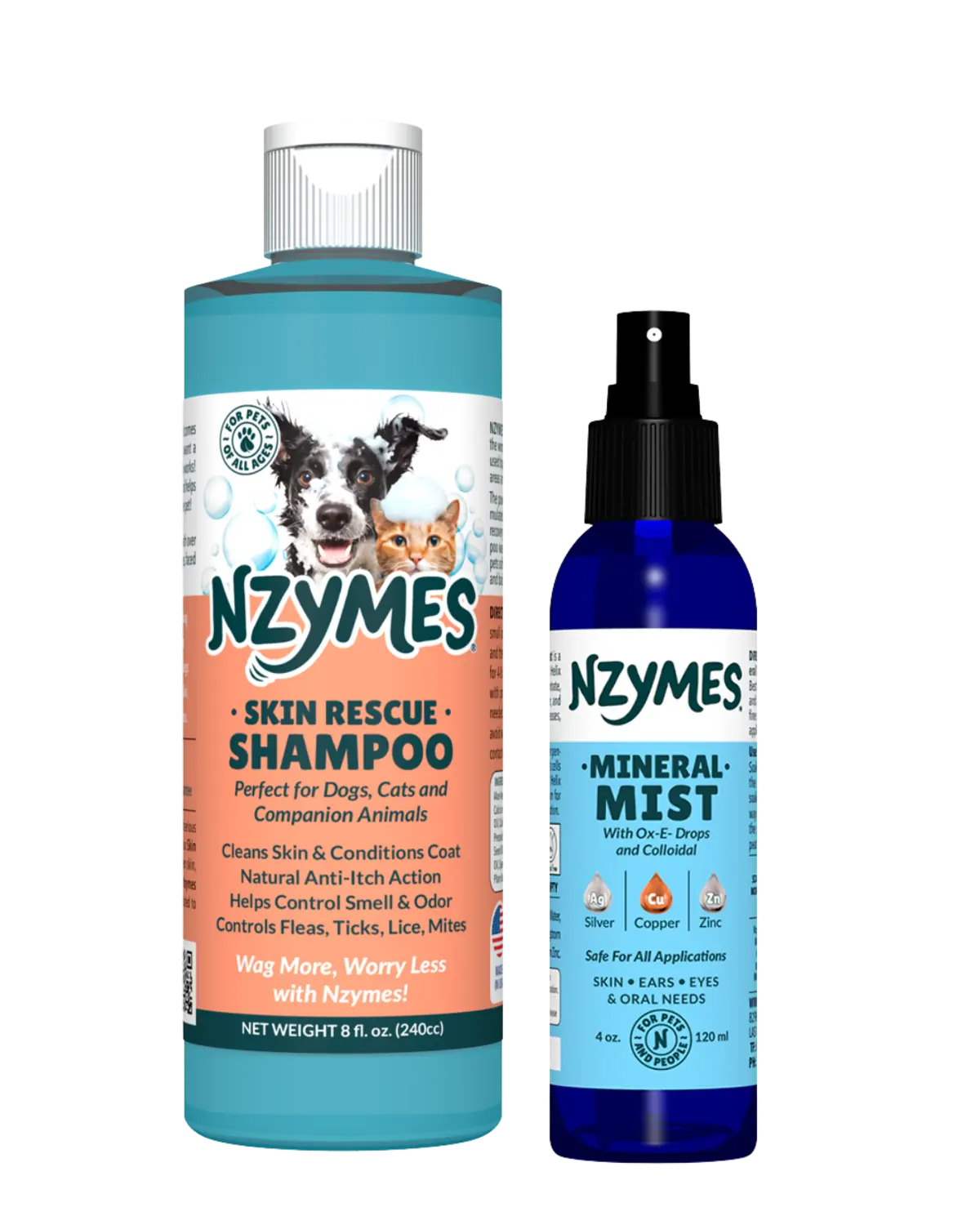
Comfort and care matter while the inside work happens, and it's why the Skin Rescue Bundle includes them. Skin Rescue Shampoo was specially formulated for these yeast cases, and Ox-E Mineral Mist brings relief right where it hurts between baths. Both are covered, with bathing cadence, on the Skin Rescue program →
Months, not weeks. The first phase of rebalancing typically runs three to seven months, roughly a month for every year of your dog's age, and symptoms often flare before they fade. The timeline above lays out all three phases, the Skin Rescue program page covers week-by-week expectations, and the interactive guide that arrives in your inbox a few minutes after ordering maps the amounts to your dog's weight.
This is the most common mistake families make. Clear skin means phase one is done, not that the gut is finished rebuilding; stopping there is how relapses happen, and nobody wants to do this twice. This is foundational nutrition: you wouldn't remove the foundation once the house is built. That said, maintenance usually means less, not more. Once the skin is clear, our team is happy to recommend what's actually needed for ongoing maintenance, and nothing you don't need. Book a free consultation →
With yeast, yes. This protocol asks more of you than most, and we'd rather be honest about that up front. A short free consultation lets us hear what you're seeing, factor in any medications, and tell you honestly whether this is the right fit before you spend anything. Call 1-877-816-6500 or book a time online. The consultation is free, and it always will be.
Yeast is one of the toughest things we help families through, and the one we most want to talk through with you before you order anything. Tell us what you're seeing and what your dog is taking, and we'll tell you honestly if this is the right fit, so you know what the road actually looks like before you start.
The consultation is a scheduled half hour with the people who know this protocol best, so your family gets real time and real answers instead of a rushed phone call. It's free, and it always will be.


.png)