
- Success Stories
- LearnThe Resource Library: guides, articles, stories


Looking for help with
Most searched
Also common
Everything else
Joints & mobility
Immune & breathing
Injury & recovery
Legs, hooves & joints
Gut & breathing

One in five dogs will develop arthritis. Pain medication is usually the first thing offered, and sometimes it's needed. It is not the only thing that helps, and it does nothing for the joint itself.
Arthritis is a degenerative joint condition: pain and discomfort in one or more joints. Research shows that one in five dogs will develop it over a lifetime, and several breeds develop it much younger than others.1 It is the most common source of joint pain veterinarians treat each year. When you first notice your dog's movement changing, it often traces to a recent or old injury; in dogs where poor nutrition was a factor, growth problems like pano or HOD can be involved.
Many cases of arthritis are directly related to inflammation, and one of the biggest sources is the food. Commercial pet foods are cooked above 118 degrees, which destroys the living enzymes, and what remains is mostly carbohydrate that the body processes down to sugar; by some estimates, roughly half of what's in the bag. Fed every day for a lifetime, that is a major driver of inflammation, stiffness and the slow degradation of the joint. Without quality nutrition the synovial fluid that cushions the joint can break down, lose its viscosity, and leave more bone-to-bone contact.
Once a vet detects arthritis, the usual next step is a prescription pain medication. For many dogs it is needed, and we don't tell families otherwise. Two things are worth knowing. First, the common NSAIDs carry real side effects, mostly to the liver, kidneys and stomach; look them up, and watch for vomiting, dark stool, lost appetite, or yellowing eyes and gums.2 Second, painkillers mask the pain. They do nothing to restore the joint or the fluid around it.
When a dog hurts, he stops moving to protect the sore spot, and that makes everything stiffer. Depending on how far along your dog is, several of these give real relief, and most work well together.
And never underestimate what a little extra attention does for a dog in pain. Stay observant, stay positive, and adjust as you go.
Some foods pour gas on the inflammatory fire. Grains have a poor reputation with arthritis, and nightshades (tomatoes, peppers, eggplant, white potatoes) are best avoided; sweet potatoes are fine. Read the ingredients on the kibble, and know that many "grain-free" foods swap in potato instead. Our recommended foods guide shows what we look for.
Then add the good stuff. Celery, alfalfa, mango, papaya and ginger are full of live enzymes that help maintain healthy joint function. Puree them: a whole celery stalk comes out the way it went in, pureed it gets absorbed. Nutrition is a powerful tool that's easy to overlook. Arthritis doesn't have to mean the end of happy frolics.
Antioxidant enzymes from living food are one of the tools nature uses to build the body's metabolic enzymes, and those power every part of recovery: the synovial fluid, cellular health, the inflammatory response. Processing takes them out of the food, so they have to go back in. Our 387-dog veterinary study measured what happened when they did: 88% of dogs with musculoskeletal inflammation showed objective improvement, in an average of eight days.
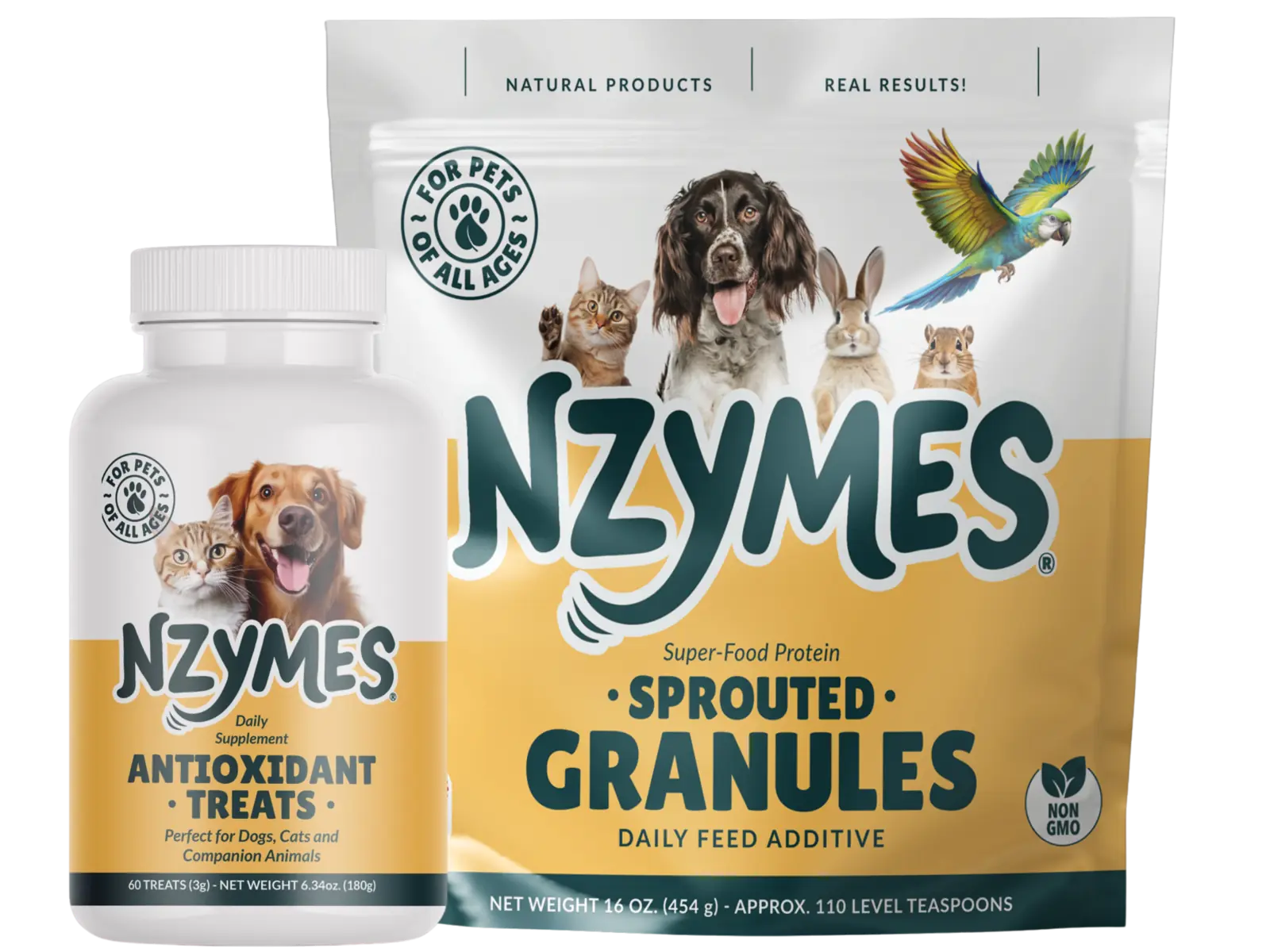 The Core FoundationSee the Core Foundation →Sprouted Granules in the bowl and Antioxidant Treats by hand: the quickest way to give your dog potent dietary enzymes that make a real difference in mobility, energy and vitality. Where every stiff, sore dog starts.
Not sure whether it's arthritis, hips, or the food? Book a free consultation and tell us what you're seeing. Diet is the first thing we'll go over.
Common. Roughly one in five dogs develops it over a lifetime, and it is the most frequent source of joint pain veterinarians treat. Some breeds develop it much younger than others.
Slow to stand after rest, stiffness that eases as the dog warms up, shorter walks, reluctance on stairs or into the car, and a dog who stops doing the things he used to do. Many families read it as "just getting old."
No. NSAIDs such as carprofen, deracoxib, firocoxib and meloxicam do ease pain, and for many dogs they are needed. They also carry liver, kidney and stomach risks and do nothing to restore the joint itself. Never give a dog human pain relievers: acetaminophen, ibuprofen and naproxen are toxic to dogs.
Gentle daily exercise and swimming, keeping weight down, chiropractic care, acupuncture, massage and physical therapy, warm and cold compresses, and a hard look at the food. Many of the families we work with do several of these together.
Underneath all of it. Live-food enzymes and antioxidants feed the body's own repair, including the synovial fluid that cushions the joint; our 387-dog veterinary study measured that in dogs with musculoskeletal inflammation. The Core Foundation is where every stiff, sore dog starts. Many families do both, and step down the medication with their vet as the dog improves.
Tell us the breed, the age, what the food is, and what the vet has said. A free half hour with the people who have walked hundreds of families through this.
The consultation is a scheduled half hour with the people who have walked hundreds of families through this, so you get real time and real answers. It's free, and it always will be.